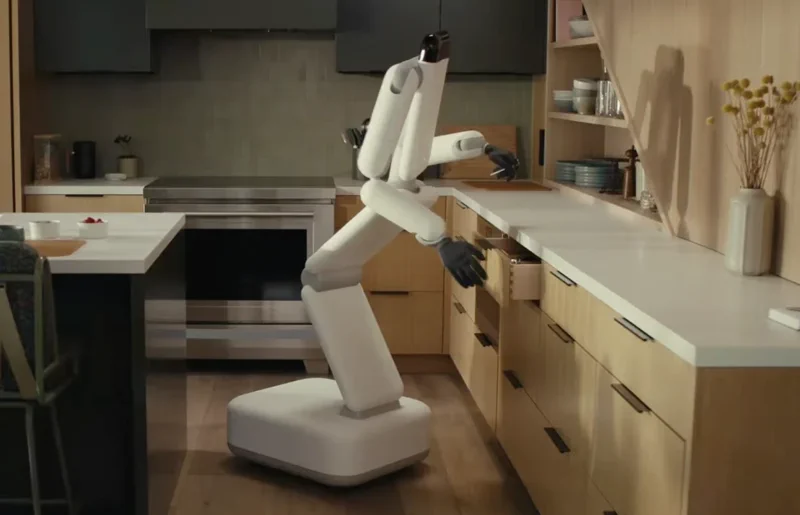
In a humanoid robotics field obsessed with creating metal doppelgängers, Genesis AI has emerged from stealth with a massive $105 million seed round and a decidedly different vision. The company just unveiled Eno, a general-purpose robot that intentionally avoids looking human. By ditching the head, opting for wheels, and wrapping everything in a seamless, appliance-like shell, Genesis is betting that the robot you’ll actually welcome into your space won’t look like a sci-fi character, but rather a piece of Scandinavian furniture.
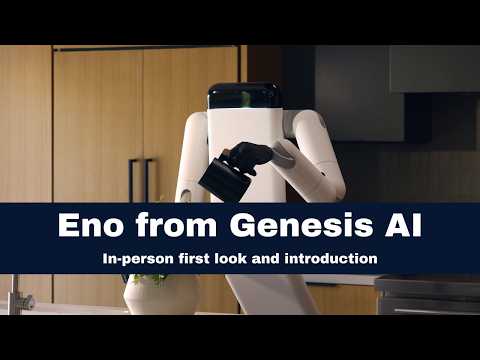
The design philosophy behind Eno is one of “essentiality and intention,” a fancy way of saying it’s built for function, not for winning a look-alike contest. Rising from a wheeled base, its articulated body can adjust its height and reach before folding down for compact storage. There are no exposed motors, no visible cables, and, as the design team proudly notes, not even any screw holes. An optional chest screen can be added to display the robot’s intent, offering a “cognitive interface” so you know what it’s thinking without having to stare into a pair of cold, dead, camera-eyes.
The real magic, however, is in the hands. Genesis AI has equipped Eno with proprietary dexterous hands that it claims match the form and function of human ones, allowing it to perform tasks with millimeter precision. This dexterity is powered by GENE, the company’s “robotics-native AI brain,” which allows the hardware and software to operate as a single integrated system. This full-stack approach, from the AI model down to the hardware, is what Genesis believes will set it apart in a crowded market.
Why is this important?
While competitors like Tesla, Figure, and Agility are pouring billions into solving bipedal locomotion, Genesis AI is making a contrarian bet: that wheels are cheaper, safer, and more practical for the environments where robots will first be deployed. The company, co-founded by CEO Zhou Xian, argues that the path to mass adoption lies in creating unobtrusive, functional “appliances” rather than complex humanoids. Backed by a war chest from investors like Eric Schmidt and Xavier Niel, this well-funded startup isn’t just building another robot. It’s challenging the fundamental assumption of what a helpful robot should look like, and its answer could very well be the “iPhone moment” the industry has been waiting for. Customer deployments are slated to begin with industrial partners by the end of 2026.